The Hand and the Glove... ramblings about making.

Ceramic 3D printing tests 02 - Why?

14.06.13

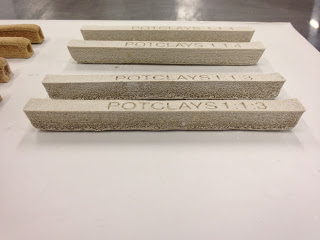
note the deformation.
The printing of the Potclays powder was a repeat of the red clay tests. 1:1:2, 1:1:3 and 1:1:4 mixtures were all successfully printed. 
It's important to leave the prints in the printer for 2 hours at the very least before removing them. Even after 2 hours some were a little soft and started to bend. Better to leave prints overnight, particularly if more complex parts are being printed.


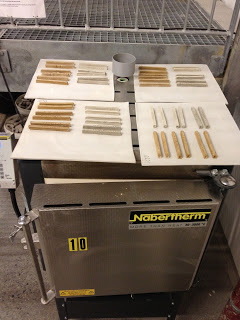
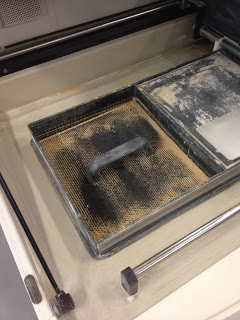
All the test bars were left to dry on top of a warm kiln overnight and this morning the excess powder was removed in the depowdering unit and the 950°C firing started.
The kiln was still around 100°C from a previous firing, but I decided to take it up slowly - 7 hours to 600°C, then 2 hours to 950°C with a 30 minute soak.

Even though we are awaiting the results of the firings, it seems a good opportunity to print a more complex form. My instinct tells me that that the 1:1:2 mixture will shrink a great deal and probably be the weakest, so I'm inclined to try the 1:1:3 powder. We will see... 


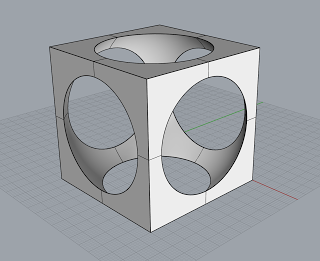
test cube
60mm test cube
First of all I quickly created a cube with a sphere removed from the interior. This gives us a simple shape, probably impossible to slipcast that has a surface that just about covers every angle. So it makes a good glaze test, as well as testing the rigidity of the ceramic powder.

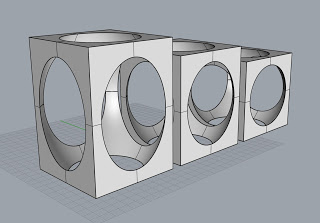
I actually set 3 versions printing, one as designed, the other two scaled one dimensionally to allow for possible deformation in the drying and firing.


test cubes
80, 70, 60 mm test cubes
It's important to remember that this is not simply a technical exercise. If successful, there may be all sorts of potential uses for ceramic 3D printing, certainly medical being one of them. But that is not my prime motivation. Rather selfishly I suppose, I hope to be able to print my artworks in ceramics thereby combining my previous experience as a maker of slip-decorated earthenware, my understanding of the 3-dimensional form and my interest in the act of making with this new, so-called post-industrial technology. So it's all about research, not technical research, though that can't be avoided, but research that engages with our fundamental relationship with objects and the making of them.
I feel it is timely to look at this area, not just because we have new tools, but because our increasing reliance on 2-dimensional screens to engage with the physical world has the potential to detach us from the sensory experience and feedback we receive when we take the trouble to venture outdoors, smell those flowers in the garden, pick up that smooth stone or spot the woodpecker calling from a tree. You probably think I'm just being romantic, after all I'm one of the generation that bridges the digital divide, but when I hear about the exciting advances in augmented reality, where it will be possible to surround ourselves with virtual objects, rather than actual, physical stuff then surely it's time to question the very nature of our relationship with objects.
WIll we need to buy another pot or painting to decorate our homes when we will be able to simply download a holographic Ming vase?

Anyhow, I'll just leave that hanging in the air...


Ceramic 3D printing tests - What?

10.06.13 – 20.06.13

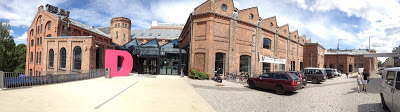
Oslo National Academy of the Arts (KHIO)


In April, I was invited over to KHIO to give a lecture about my work and to meet the staff in both the ceramics and D-Form departments. Paul Scott, one of my colleagues in MIRIAD is a Professor 2 at KHIO and had the idea to arrange a collaborative venture around the theme of ceramics and print, something that has been a specialism of his for a number of years. However, the planned event is to focus on the 3D printing of ceramics, something that Trine Wester who runs the D-Form 3D printing facility has started to explore.

Back in Manchester, we have acquired 2 ZCorp 406 3D printers, both in need of restoration. The plan is to restore one of them and use it to continue the ceramic printing experiments. Whilst I am waiting for the printer to be housed in a suitable room, I thought a very good use of my time was to head back to Oslo to learn about using ZCorp printers by working with the D-Form team. This time I was keen to explore the ceramic powder that Potclays had developed for 3D printing. I purchased 15 kgs, which just fitted into a small suitcase and passed through airport security without any questions!

On the Monday morning we made a good start by moving the printer, de-powdering unit and computer down into the ceramics department.

The plan was to test and compare red earthenware with the Potclays powder. The recipes are as follows:

RED CLAY
POTCLAYS
ICING SUGAR
MALTODEXTRIN
2

1
1
3

1
1
4

1
1

2
1
1

3
1
1

4
1
1

Each batch was prepared in 3kg batches. Once printed the tests would be fired in batches to 950°, 1000°, 1050° and 1100°C.


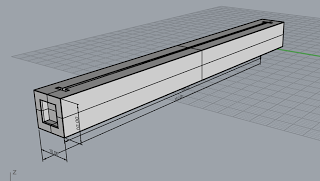
I designed a small test bar with a precise 100mm slot in the top to be used to accurately measure shrinkage.

On Tuesday morning the first tests were printed.

There follows a description of how the printer was prepared:


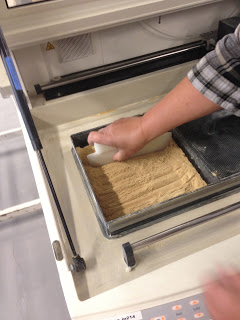
1. Compacting the powder.


2. Levelling the powder


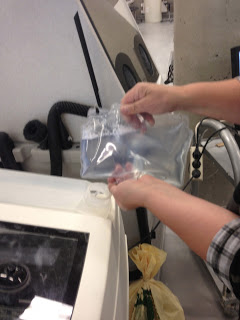
3. Filling the binder tank with zp61 binder fluid


4. Cleaning the print head parking dock with distilled water.

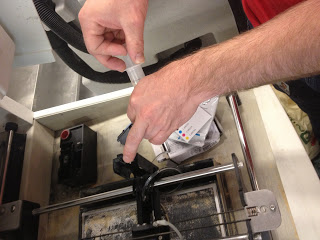
 5. Purging the HP10 print head of ink and 
 bleeding the binder tube for air bubbles.


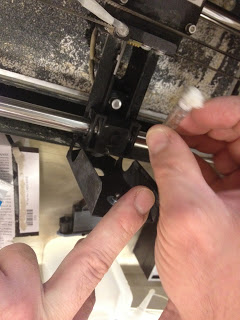
6. Cleaning the print head 'pogos' with an alcohol swab.
(Squeeze the tube to release the alcohol)


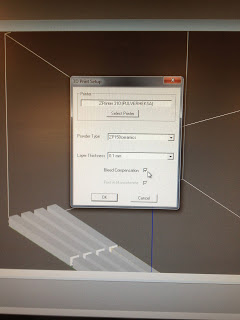
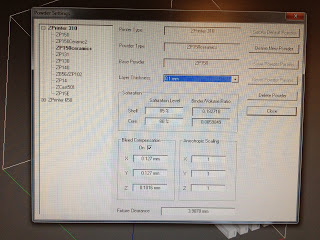
7. Print settings, 
(note the Bleed Compensation is checked).

8. Powder settings, note that in all other 
tests the Shell was 90% and the Core was 85%

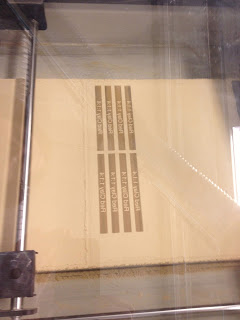
9. Printing the binder, (note some ink still visible).
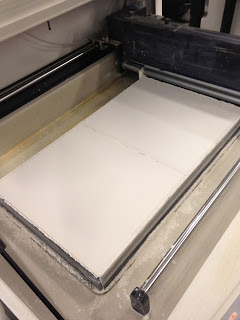
10. Potclays 1:1:4 powder, smoother
 and finer than the red earthenware.


Tomorrow we print more Potclays powder variations, so that the firings can commence on Friday.

More to follow...

Leap Motion

Alongside my exploration of 3D printing I am also interested in the software that we engage with to create the virtual artworks. Standard CAD packages were designed for engineers and more recently, animators. As I am neither of these, I find that the software has its limitations. Though there are a number of applications, such as Sculptris and Forger (available for iPad and iPhone) that involve intuitive manipulation of clay-like primitive solids, they go too far in the other direction. I need something that bridges the space in between, in other words a CAD package where I can generate controlled and accurate curves and convert them into 3 dimensional forms and then work intuitively, stretching, pulling, pushing, adding and subtracting in the same way as I do with clay. If anyone reads my ramblings they may reply to say that they already exist in packages such as Freeform, but have you seen the price? And I’m not sure whether it’s possible to import precise forms and then manipulate them. So, I stay with Rhino3D, as it’s what I have used for the past 7 years and works well within its parameters. 

 And then along comes the Leap Motion, a small USB device that according to the manufacturers promises:

 “With a wave of a hand or lift of a finger, you’re about to change the way you use your computer. The Leap Motion Controller senses how you move your hands, the way you move them naturally. So you can point, wave, reach, and grab. Even pick something up and put it down. Just like in real life. It’s an amazing device for the things you do every day and for things you never thought you could do.” 

 I immediately signed up for a pre-order and then applied to receive one as a developer. I figured that someone here would have coding skills beyond my HTML. I gave it to Lewis Sykes, a PhD candidate here at MIRIAD, who passed it on to Ben Lycett, our new coder in residence. And within what seemed like hours, he had started to create a 3D application where the hand can draw a line in space that can be revolved to form a 3D surface. 

 There’s much more to be done and there’s a large community working on Leap Motion apps for all sorts of uses out there, so maybe my wish for an intuitive, but controllable CAD package is a little closer. 

 We will see, I'll report again as we make progress...

Where do I go from here?

-->
April and May have been busy, a pretty hectic combination of work and play. 

It started with a trip to Oslo National Academy of the Arts, where I was invited to give a lecture about my practice. It was also an opportunity to meet the staff in both the Ceramics department and in the 3D printing facility. The facilities are extremely impressive, all housed in a beautiful 19th century sail factory complex.
I am planning to return for a longer period in order to experiment with their ZCorp 310 that they have just started to use with ceramic powders. The plan is to create a network of 3D printer practitioners exploring the theme of ceramics, culminating in an event in the autumn of 2014.

A few days after my return to the UK, I set off for a holiday in France with my wife Vicky, our friend Jan and my bike. The trip by train to Montelimar was excellent, though carrying my road bike in a bag wasn't that easy. Whilst there I cycled from the Drôme, through the Gorge de L'Ardeche, down into Languedoc to see friends, then up through the Cevennes to be reunited with Vicky and Jan in Ispagnac, a beautiful village at the entrance to the Gorge du Tarn.

I had to cut the holiday short in order to return to London for Collect, held again at the Saatchi Gallery, where I was showing some new pieces with Adrian Sassoon. The show was definitely up to it's usual standard, and I was lucky to have the Prtlnd Vase purchased by the Art Fund for the New Walk Gallery in Leicester. The curators plan to open a digital gallery and had researched my work and in particular the Prtlnd Vase for their presentation to the Art Fund.
Whilst at Collect, I took part in the first ‘Fielding Talk: Lives in Craft, launched in memory of Amanda Fielding, the writer and curator who died in 2012. This event, …celebrates Fielding’s passion and knowledge for the sector through the voices and experiences of the most exciting and innovative makers in contemporary craft.’ Glenn Adamson from the V&A chaired it with Clare Twomey and myself in discussion around the theme of the relationship between makers and curators. The acquisition and positioning of ‘digital craft’ has been problematic for curators as there was uncertainty as to the placing of the work. Fortunately for my contemporaries and I, there now appears to be a confidence and keen interest in our work, though the interpretation of challenging pieces can still be problematic for the curators.


Back in Manchester, I have been continuing to explore the Mcor Matrix 300 printer that 'prints' in layers of paper. It has been a temperamental machine, but a technician’s recent visit appears to have made it operate more smoothly. I set it off this morning to print the first of 4 pieces to be used as moulds for the making of ceramic sprigs for a version of the Prtlnd Vase. The body of the vase was printed in 4 sections by Mcor, as our machine failed to build them. I plan to have a mould produced and if talks with Wedgwood succeed, I will slipcast it in traditional Jasperware.

-->
And this leads to the question I pose in the title of this piece, “Where do I go from here?’ The reason I ask this question is that I am going through a period of reflection about my work. Over the past 7 years I have produced a body of work that has investigated 3D printing through the interpretation and re-design of familiar objects such as Wedgwood and Sèvres ceramics, appropriating their cultural significance to make comments about craft, values and the virtual world that we increasingly inhabit.
As I have always said, I don’t want to use the technology for its own sake, there has to be an idea that underpins its use. I am now at the stage where I feel I need to go further, in terms of material and process. The aim has been and still is to produce ceramic 3D printed artworks, combining my previous experience and knowledge of ceramics history with ‘post-industrial’ manufacturing. But this is where Glenn Adamson steps in.
-->In his new book, ‘The Invention of Craft’ he states that “…new forms of practice will inevitably be forged through the synthesis of the analogue and the digital…”[1]
The Mcor Matrix printer alerted me to the journey the data travels between the computer software and the printed artwork. The only difference between the data used to produce the paper prints of the Prtlnd vase and the SLS version, is scale. However, unlike the SLS original the faceted sides look as though they have been made from folded paper. Something has happened in the process that gives the object a softer, ‘crafted’ look. So this version will not only refer to the relationship between actual and the virtual from the standpoint of our increasing engagement of the real world through a screen, but also record the material process.
The other thought-provoking piece of writing comes from Justin McGuirk in the Collect 2013 catalogue. He is talking about craft ‘fetishism’ and the difference between being seduced by electronic gizmos and crafted objects. “The philosopher Bruno Latour might argue that we are once again seduced by the ‘thingness’ of things. In his essay ‘Why has critique run out of steam’ he extrapolates Martin Heidegger’s distinction between objects and things. He writes ‘The hand-made jug can be a thing, while the industrially made can of Coke remains an object. While the latter is abandoned to the empty mastery of science and technology, only the former, cradled in the respected idiom of art, craftsmanship and poetry, could deploy its rich set of connotations.’ So we have a distinction here between the mute machine-made object and the poetic hand-made thing. Does this distinction help us?”[2]
And where does it place my work?
Do I fall between the 2 stools? And is this why I feel I need to bring a physical, tactile connection back into my work?
I shouldn’t care what the Adamsons and McGuirks think, as I am a maker not a critical historian, writer or philosopher, but even before my days at the RCA I have attempted to justify my output. It’s part of my methodology and one that sometimes weighs heavy.


[1] Glenn Adamson, The Invention of Craft (London: Bloomsbury, 2013) p.166
[2] Justin McGuirk, Fashion, Fetish and Craft, (Crafts Council 2013) pp.19, 20

Essays, dissertations, theses etc. etc...

One of my friends from the RCA is now working at the National Glass Centre in Sunderland and asked me for a .pdf version of my RCA thesis for their library. When I have finished converting it to .pdf, I’ll also send it to the RCA library where it will be available to students.

And yesterday, I received an email from a student at the Sotheby’s Institute who asked a number of incisive questions about my practice. From time to time students have asked to use my work in their essays and dissertations, so I thought it might be useful to reproduce the questions and my replies.

You mentioned in your blog that a new Arts and Craft movement may be necessary and that technology does not warrant good design and that a material led process is still essential. What do you think is the appropriate way to combine traditional craft with high technology in this age?

In Britain, at the present time there is a lack of joined up thinking by our political leaders. The Chancellor, George Osborne stood up at the dispatch box in the House of Commons to say that Britain's economic recovery will happen through the hands of makers, in other words there is a need to apply our creativity to manufacturing innovative products in the UK. Last week the Culture Minister, Ed Vaizey was on Radio 4 championing British 'world leading creativity'. However, down the road in the Ministry of Education, Michael Gove was set to remove the Creative subjects from the curriculum through the introduction of the English baccalaureate. Though the proposal has been dropped, there is still a threat to the rating of schools through the use of EBacc criteria where the creative subjects are not taken into consideration. Where does he expect the next generations of creative thinkers to come from? 
Hopefully, you will be able to see where my tirade is heading. There is a real need to recognize the place of making at all stages of the education system. It must go hand in hand with the use of technology, in fact there is a need to be far more creative with technology, so that coding should also taught in schools. 

My generation spans the digital divide, I grew up before computers and spent a lot of time making and building stuff, it was what we did. So computers are something that I have seen as 'other' whereas generations growing up with computers and digital technology don't have the same potential hang-ups. The way forward is not to differentiate between digital and non-digital tools. They can be used singly, separately and in harmony. It's all about choosing the right tool for the job. But in order to make the correct choice the maker has to have experience of both sets of tools.

The definition of the word 'craft' has evolved over the years. The Arts and Crafts movement had a particular definition, relating to the inhumanity of the Industrial Revolution. It may have been the blinkered view of a privileged class, but it was very influential, encouraging generations of makers to head off to the countryside to grow vegetables and make heavy brown pots! Urban makers reacted against this in the 1970's and craft to a large degree became a dirty word, especially as conceptual ideas seemed to be the only thing that counted in the Art world.

I think that the definition of craft is changing again, with academics such as Malcolm McCullough, Richard Sennett, Glenn Adamson and Christopher Frayling helping to re-define the word. And the boundaries between the disciplines are becoming blurred, personally I define myself as maker, someone happy to inhabit and explore the grey area between art, craft, design and technology. 

To quote Alex Coles, “…Eden’s work is persuasive evidence of how one of the most convincing ways to extend craft today in order to integrate it more closely with art and design is precisely by using cutting-edge technology to trigger a process of conceptual and formal investigation. By aiding experimentation in this way, technology is utilized as a means to an end rather than simply being an end in itself.”[i]


Could you expand on why and how you incorporate the virtual experiences? The QR code is a great example of this. Does this reflect that decorative objects will need to serve additional functions, to entertain its audience, to remain relevant? 

A beautifully crafted teapot does not require an additional contrived virtual dimension to complete the users experience of brewing tea in it or appreciating it, sat on a shelf in the kitchen. The owner of such an object develops a relationship to it through use, through sharing a cup of tea with friends. Its physicality is enhanced by those sensory and emotional experiences, it needs nothing more.
However, as information becomes increasingly available through data it is now possible to not only realize information as objects but to interact with them in new ways. Both the Mnemosyne and the Babel vessel have been acquired by museums (Carnegie Art Museum, Pittsburgh and Aberdeen Art Gallery respectively). I plan to work with their web designers to allow the viewer/user to interact with them in meaningful ways, creating links to other objects in the museum and allowing new stories to be told. I see them. 
I don't think these pieces are superior to non-interactive pieces, they simply offer another type of experience.

What motivates and inspires you? 
You have included cultural and historical references, as seen in the Wedgewood Tureen, what is their significance in your works?

I hang a story on culturally significant objects as a way of commenting on making, encouraging a debate around craft and to tell a multi-layered story. But they are also chosen to seduce the viewer by their familiarity. I want the viewer to engage, to be surprised, to have their perceptions challenged.

To whom are you designing for? What type of home do you see your pieces in?

Primarily for me, it's self-indulgence. But I hope that this approach will connect the objects to an audience. I hope that I make artworks with integrity and passion and that the viewer recognises the energy and effort that goes into them.

What are your findings in working with a synthetic material? Do you miss the tactile nature and the warmth of clay?

My eventual aim is to 3D print clay. I have collaborated with others to produce a few 3D printed ceramic pieces, some of which I have successfully fired using the same lead glazes that we used on our slipware. The aim is to bring together the almost pre-industrial craft skills and materials that I previously used with post-industrial manufacturing, thereby creating a new ceramic language. Meanwhile, it is important for me to explore and fully exploit the technology and materials available to me. Nylon is not clay, never will be, but I can hopefully still use those materials to make meaningful objects. And they are a challenge to experiment with, so i have been copper plating and exploring silver plating amongst other trials.

Babel Vessel I:
I have read that the Chinese 'hu' vessel was an inspiration to you. Can you expand on your choice of this form and culture?
Unicorns adorn the side of the vessel, what do they symbolize?

On a visit to the British Museum I noticed the surface decoration of a 6th century BCE Chinese ceremonial wine vessel, known as a hu, as it reminded me of the QR barcodes.
When translated, the Chinese symbols tell of battles won or of heroic deeds by emperors. Like the QR code, I wasn’t able to read them without a translator (or an App). So the viewer can scan the Babel Vessel with their Smart phone, which then connects to a video on my website telling the story, providing additional information thereby creating a simultaneous actual and virtual experience.

The lion and the unicorn handles replace the traditional Chinese serpents and make a cryptic reference to the uncomfortable relationship that has existed between Britain and China at various times in our histories. They also (positively) refer to the Royal College of Art (taken from the Royal Standard logo of the RCA), without which I wouldn't have been able to make these things.


[i] Coles, Alex. ‘Michael Eden, The Practitioner, Artist, Designer.’ SOFA 2011 catalogue essay.
Alex Coles is the author of DesignArt (Tate Publishing, 2005), co-author of Project VITRA (Birkhauser, 2008), and the editor of Design and Art (MIT/Whitechapel). He also writes regularly for the Financial Times and The Art Newspaper.